Send the mix
WAV or AIFF, no limiter on the bus, and a reference if you have one.
You send the mix, I master it in my Frankfurt room and send the files back - tuned for Spotify, Apple Music and Beatport. Real analog gear, digital where it has to be precise, and one engineer who listens to your reference. The first 60 seconds are on me.
17 years of professional sound work. Hybrid analog chain, precision monitoring, one dedicated engineer.
WAV or AIFF, no limiter on the bus, and a reference if you have one.
60 seconds of your track through the chain. No card. You decide on your own system.
Hybrid analog summing, gentle compression, surgical EQ, transparent loudness, tuned to your reference.
Streaming-ready 24-bit master, optional club or radio versions, one revision included.
Tell me your target loudness, reference and format. The chain is tuned per song, never a preset.
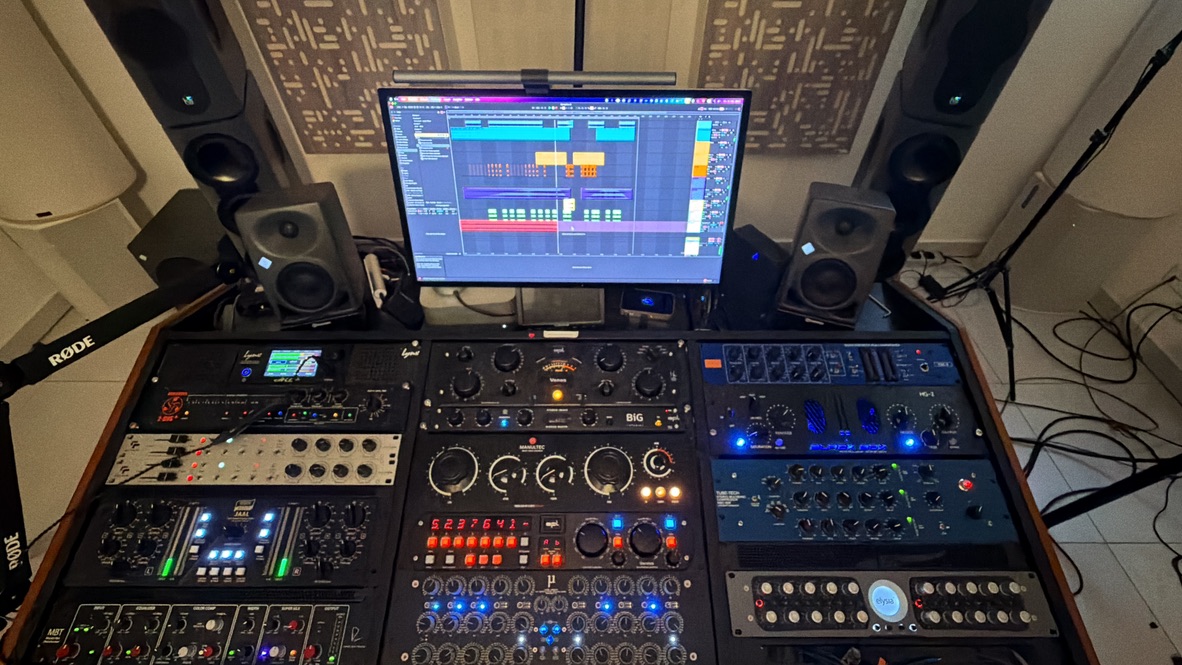
The signal actually leaves the computer. Your mix runs through real outboard - transformers, tubes, discrete circuits - and that is where the tone, the glue and the weight come from. Hardware behaves differently under load: it saturates, it leans, it holds the low end together at levels where a purely digital chain starts to sound stiff and small. Then the signal comes back in, and I use digital only where digital is genuinely better - surgical EQ moves, true-peak control, loudness that survives every codec.
An automated service cannot do this, and it is honest to say why. An automated chain measures your file, compares it to a statistical target and applies a curve. It has never heard your reference track. It does not know that the vocal is meant to sit slightly behind the synth, that the sub is deliberately loose, or that this is the third track of an EP and has to sit between two others. It cannot ask you a question, and it cannot be wrong on purpose in a way that serves the record.
I can. That is the whole difference. Every setting is made for your song and nothing is recalled from a preset. Decisions are made on Kii Three monitors with PSI AVAA bass traps and Trinnov room correction, in a room I know well enough to trust at low volume and at club volume. If a move does not help the song, it does not happen - even if it would make the meter look better.
Read the full human vs. automated mastering comparison, or go deeper on the analog mastering chain itself.
Most of what comes through this room is dance music, and dance music has its own rules. Techno mastering lives or dies below 120 Hz: if the kick and the bass are locked, the track gets louder on its own and stays punchy on a big rig at three in the morning. House mastering usually asks for the opposite kind of care - the groove has to breathe, so over-compression that flattens the swing is worse than being a decibel quieter. Tech house, minimal and Afro house each sit somewhere between those two, and I set the chain accordingly rather than reaching for a genre preset.
Club and streaming are also two different targets, and I will happily deliver both. A club version keeps headroom and lets the sub stay intact for a system with real low end. A streaming version lands between −9 and −14 LUFS with a safe true peak, so nothing clips after Spotify, Apple Music or Beatport re-encode it. If you want the release to carry the Apple badge, the Apple Digital Masters workflow is part of the standard process here, not an upsell.
Vinyl is its own master again. A loud digital file pressed onto a lacquer gets thin, distorted or simply unplayable, so a vinyl premaster is planned around side length, with bass managed so the cutter head can track it and sibilance controlled before the plant complains.
Also in this room: Techno & house mastering · Vinyl mastering · Analog mastering · Stem mastering · Apple Music mastering
Every new account gets one free test master. Same chain, same engineer, no card required. 60 seconds of your track, full chain. If it isn’t right for the song, you haven’t lost a thing.
Wondering how this compares to automated mastering? Read the honest comparison.